How to Actually Choose Your College Criteria (Not Just Chase Rankings)
Some of my favorite photos from the last few years are from college visits with my daughters — standing in front of a building we'd later forget the name of, squinting into the sun on a campus tour, the exact moment one of them turned to me and said “I could see myself here.”
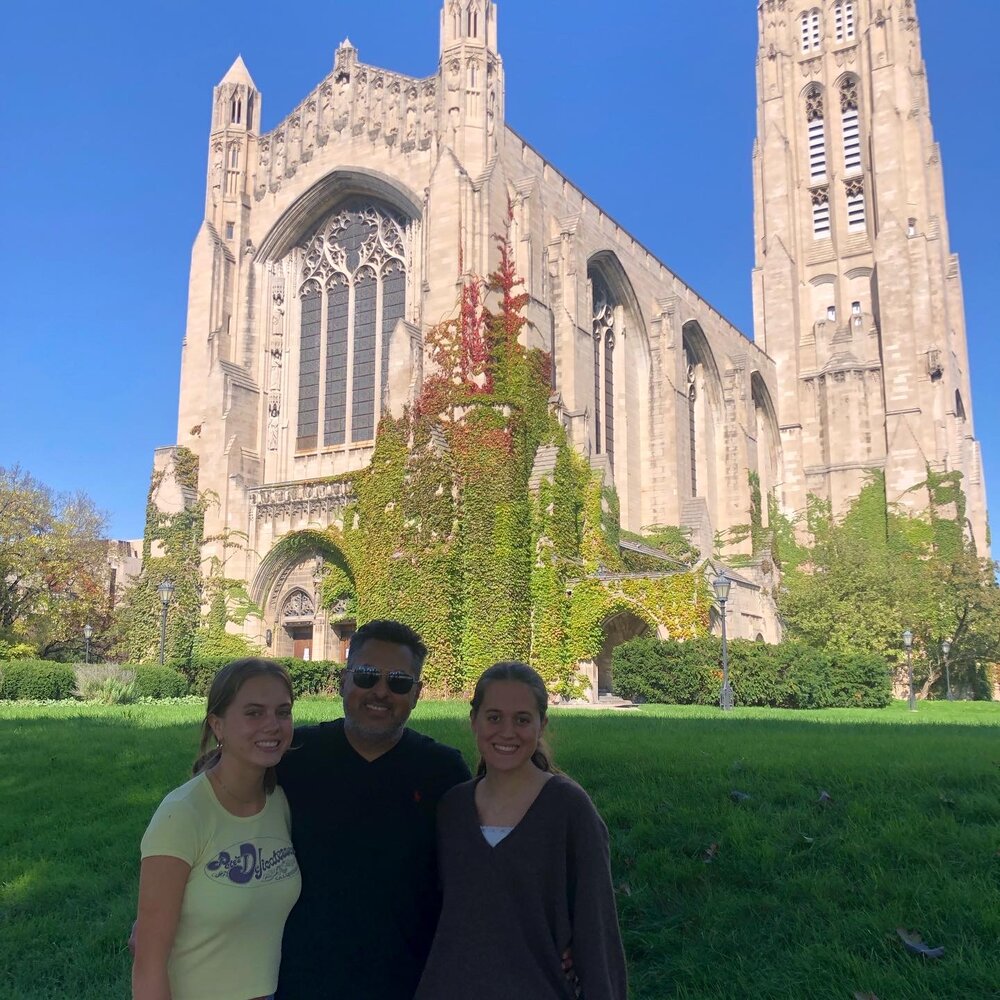
One of our first college visits together — University of Chicago. With only one grade between our daughters, we were able to visit schools they were both interested in at the same time.
That feeling — I could see myself here — is real, and it matters. But it can't be the only thing driving a college list. I've watched families (including my own) either chase a school's name recognition and ignore everything else, or get so buried in spreadsheets and rankings that they forget to ask the more basic question: what actually matters to this student?
Rankings are a starting point, not an answer
It's tempting to just sort by the highest-ranked school you got into and call it a day. But the difference between a school ranked 8th and one ranked 18th is genuinely small — often smaller than the difference between two schools with completely different vibes that happen to sit next to each other on a list. Rankings compress a lot of very different things — research funding, selectivity, alumni salaries — into one number. That number tells you almost nothing about whether you'll be happy there.

Our first visit to UW-Madison — a campus one of our daughters could immediately picture herself on.
What the research actually says matters
I'm not the only one saying this. A recent Washington Post survey of counselors, researchers, and policy analysts converged on four factors that mattered most, over and over: affordability, academic fit, social fit, and graduation outcomes. Notice that “prestige” isn't on that list.
Separately, research from EAB (an education research firm) found that location is the single factor first-time college students most often name as the reason they chose their school — even ahead of academics. And nearly half of students weigh financial aid and affordability as one of their top two reasons for choosing where they land.
In other words: the things that actually predict whether a student thrives are rarely the things a ranking measures.

A side trip to visit the University of Texas at Austin — a completely different feel from the others, and worth seeing in person to know for sure.
So how do you actually figure out your criteria?
This is where I always tell families to slow down before they speed up. Before you touch a spreadsheet, ask the more basic question: when you picture your ideal college, what comes to mind? Not the name of a school — the feeling. A big lecture hall or a table of eight in a seminar? A campus in the middle of a city, or one you'd need a bike to cross? Somewhere three hours from home, or somewhere you'd need a flight to visit?
From there, it helps to sort what you're picturing into real categories — things like size, location, cost, academic programs, and campus culture. Every family's list looks different, and that's the point. The student who wants a huge football culture and the student who wants a tiny discussion-based classroom are not going to build the same list, even if their grades are identical.
The part most families skip is the next step: not just listing what matters, but being honest about how much each thing matters relative to the others. A student who says “I want a big city and a small class size” needs to know those two things are often in tension — and it's worth figuring out, early, which one wins if you have to choose.

A stop at Yale on the way to another visit — we didn't linger long, since at the time we weren't sure it would be the right fit. Funny how these things go.
This is the part I actually help families with
This is genuinely one of my favorite parts of the whole process to work through with a student — not because the answer is complicated, but because most students have never been asked the question directly before. I walk every Bello Advising student through a structured version of this exact exercise as the very first step in building their college list — because everything else (which schools to research, how to spend a campus visit, even what to write your essay about) gets so much easier once you actually know what you're looking for.
If you want to work through this with real guidance — not just a blog post — join one of my free info sessions, or book a free intro call. And if you're not sure where to start, that uncertainty is exactly the starting point. That's what the first conversation is for.
— Maggie